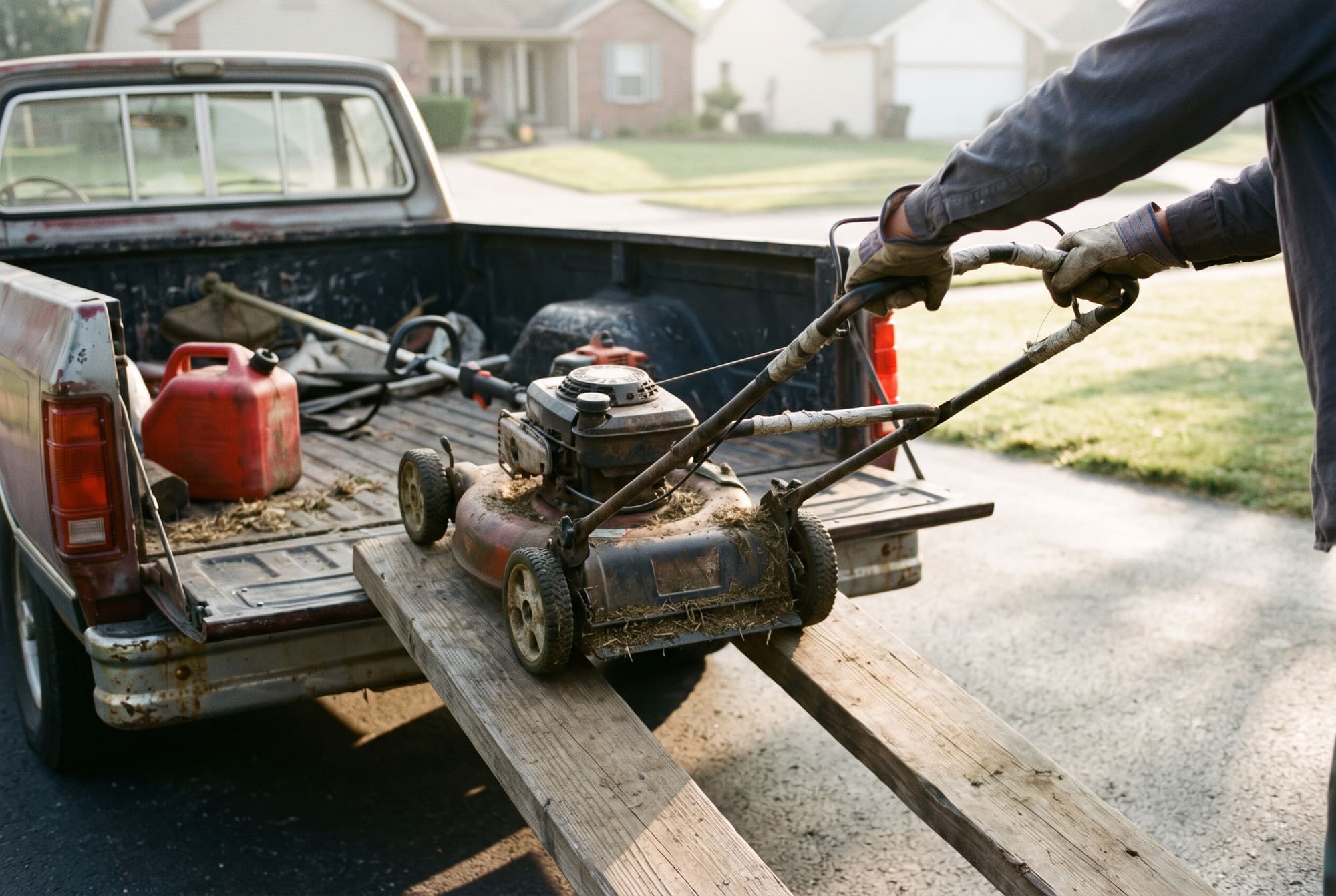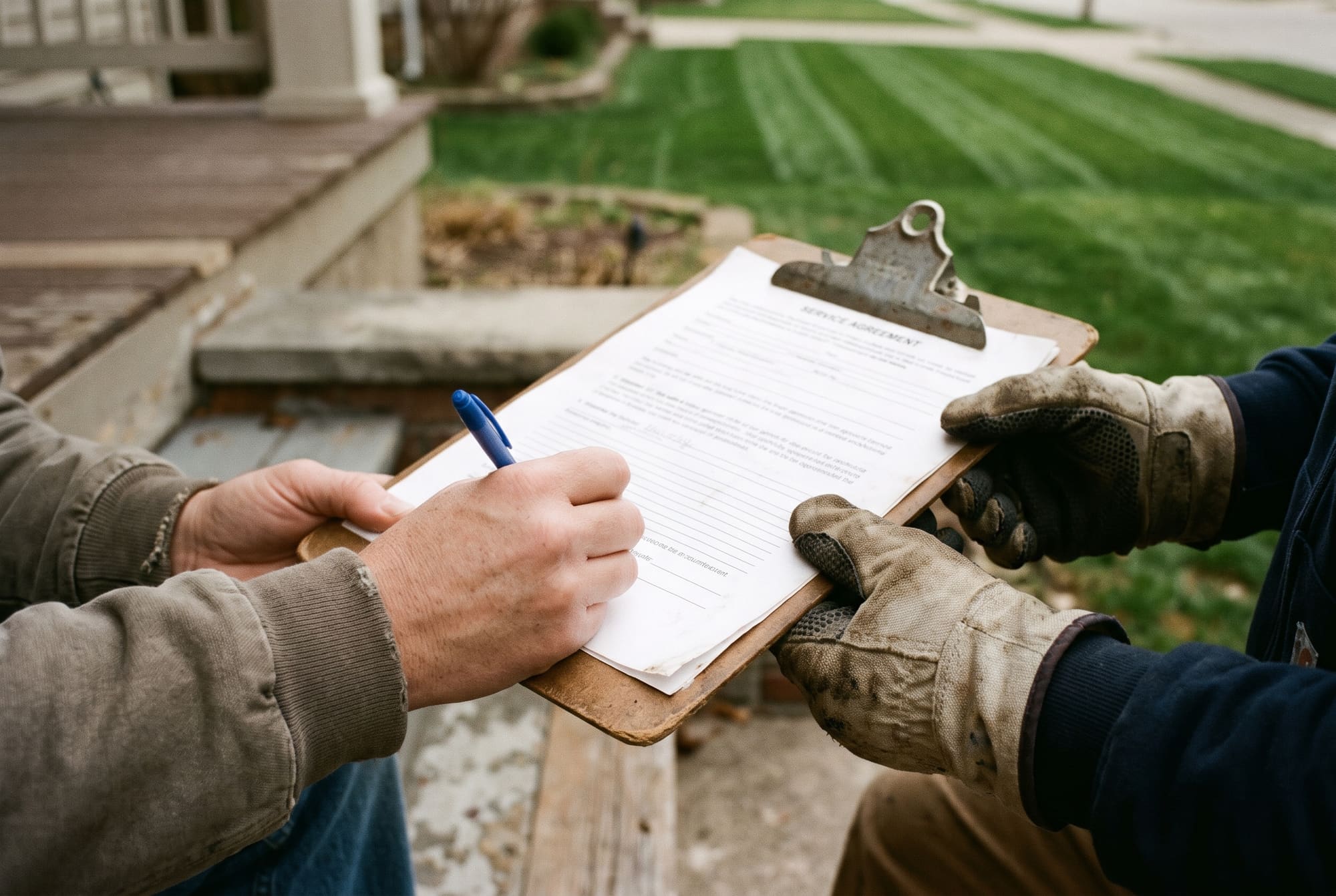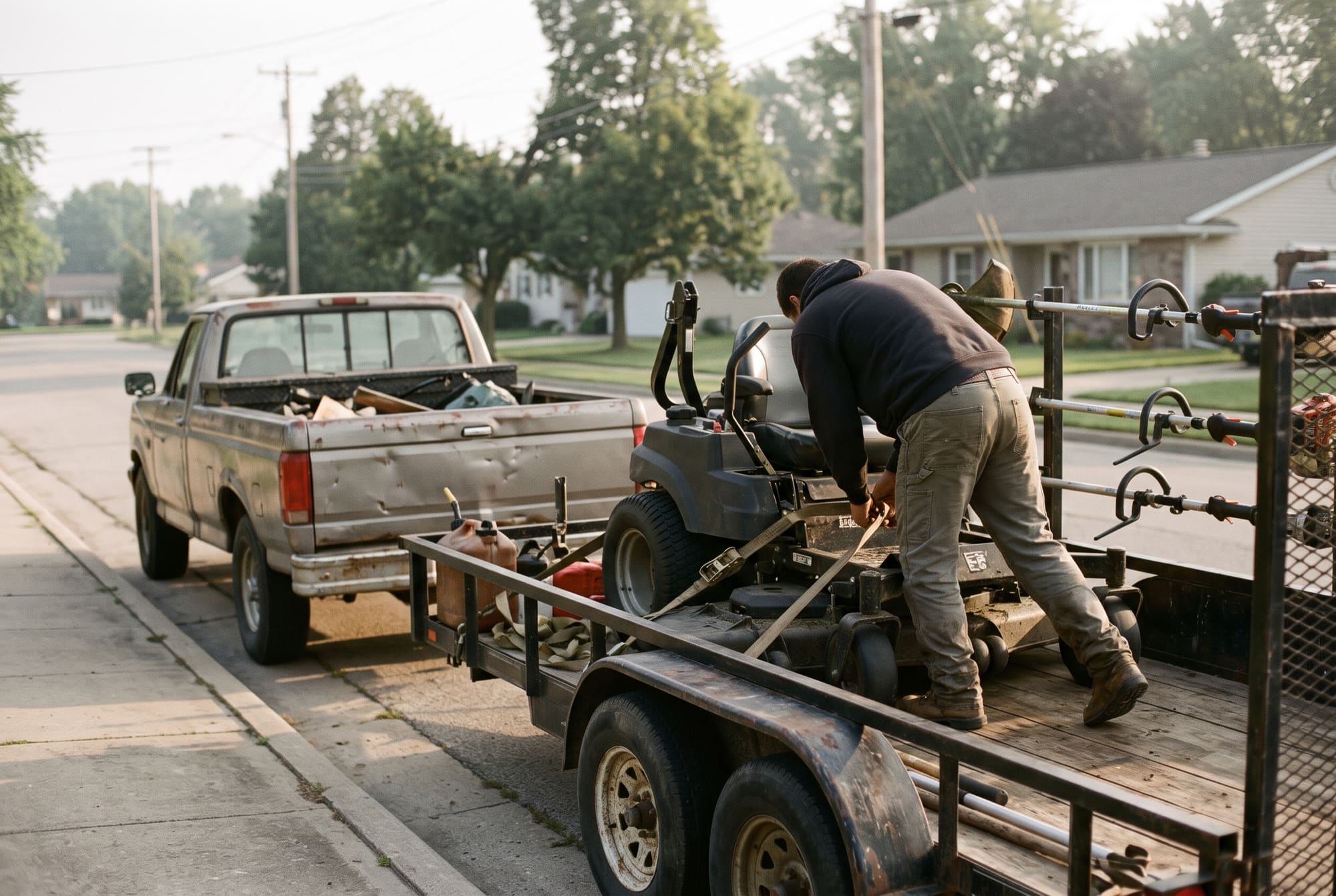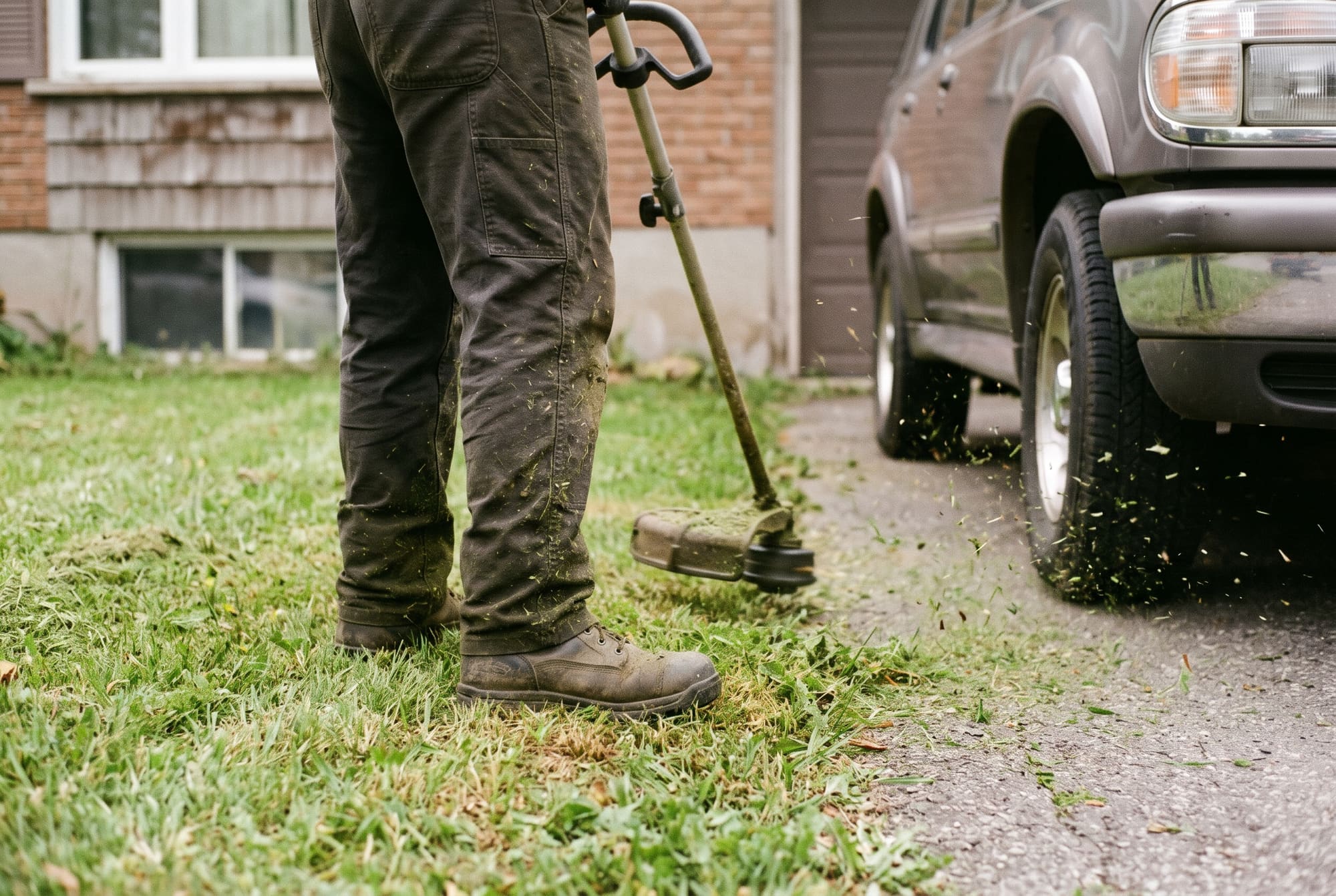
Lawn care business insurance helps protect your company when a job goes wrong outside: a rock thrown by a mower through a client's patio door, a zero-turn stolen off your trailer, a fender bender with the trailer hitched, or weed killer that drifts onto the neighbor's flowerbed. Most lawn care businesses start with general liability coverage for property damage and injury claims, then add commercial auto, equipment coverage and workers' compensation as the crew grows. If you run mowing or landscaping as a real business, sooner or later one of those claims lands on your desk.
I ran a 6-person lawn crew in Columbus, Ohio for seven years. This guide covers which insurance coverages a lawn care business needs, what they cost according to published data, what that means by crew size, pesticide licensing rules, state requirements, and what to check before adding snow removal.
Important: this article is general information, not insurance or legal advice. Coverage, prices and requirements depend on your state (or province) and on the carrier. Read the policy wording and check with your state agency or a licensed agent.
What insurance does a lawn care business need? (Quick answer)
Most lawn care businesses need liability coverage first, usually at $1 million per occurrence and $2 million aggregate. Add a commercial policy for your truck and trailer, inland marine coverage for mowers and trimmers, and comp coverage for employees once you hire. Larger contracts with property managers or towns may also require an umbrella policy.
Scroll sideways to see all 3 columns
| Crew size | Must have | Add when you can |
|---|---|---|
| Solo operator | General liability, commercial auto (if you haul for work) | Tools and equipment |
| 2 to 3 person crew | General liability, commercial auto, workers' comp (where your state requires it) | Tools and equipment, umbrella |
| 6 or more | General liability, commercial auto, workers' comp, tools and equipment | Umbrella, pollution coverage if you apply chemicals |
Do you need insurance to mow lawns?
Mowing for extra cash vs running a business
If you mow a few neighbors' lawns on weekends, what you owe the state depends on where you live, so check your state and city rules. In the states in our table below, the licensing and insurance rules we found kick in when you hire employees, take on construction-type work (hardscaping, irrigation, installs) or apply pesticides for hire. California, for example, says gardeners who maintain landscaping on a regular basis generally do not need a landscaping license (CSLB, rev. January 2025).
Once you run it as a business, the picture changes. Business customers, HOAs and property managers almost always ask for proof of insurance before they sign. No certificate, no contract. And your homeowner's or personal policies will usually not cover business work. The Insurance Information Institute says most homeowners policies exclude business liabilities, and Progressive Commercial says a personal auto policy usually won't cover an accident that happens while you're working (both consulted November 9, 2026).
What happens if a client or neighbor sues
The classic lawn care claim is a projectile. Your mower picks up a rock and sends it through a car window or a sliding glass door. Without insurance, you pay for the glass, any injury, and a lawyer if it goes further: a real financial hit for a small company. With the right coverage, the carrier handles the claim, minus your deductible.
If it happens to you: stop the mower, photograph the damaged property and the spot you were cutting, get the customer or owner's contact details, and report the claim to your carrier the same day, before you promise to pay anything yourself. Keep a note of the date, address, crew member and equipment involved.
Lawn care and landscaping insurance types explained
Most policies sold as "landscaping insurance" or "landscaping business insurance" also cover mowing, edging and basic yard maintenance. You don't need a separate lawn care policy, but you'll need to list every service you offer on the application, because the quote is based on it. If you're unsure whether a service is included, ask before you buy, not after a claim.
General liability for lawn care businesses
This is the coverage most lawn care businesses buy first. It can help cover injuries to other people and damage to their property caused by your work. Lawn care examples: a thrown rock breaks a window, a trimmer line chips a customer's car, a client trips over a hose you left across the walkway.
Exclusions to ask about before you buy this insurance: damage to underground sprinkler lines and invisible pet fences, tree work above a certain height, and chemical drift (see the pesticide section). Wording differs by carrier, so ask each one to point you to the relevant exclusion in the policy itself.
Commercial auto and trailer coverage
If your truck is used for the business, it needs a commercial policy. Ask two separate questions about the trailer: is it insured for liability while hitched, and is damage to the trailer itself included? Progressive Commercial says utility trailers are common among landscapers and that utility trailer coverage can be customized to protect the trailer and what you carry (consulted November 9, 2026). Make sure the trailer is listed on the policy, so your coverage can help protect both the trailer and the tools on it.
Tools and equipment (inland marine) insurance
This covers mowers, trimmers, blowers and other gear on the job site, in transit or stored. It's the policy that pays when a zero-turn disappears from your trailer. Unlike commercial property insurance, which protects a building and what's inside it, inland marine follows your machines from job to job.
Read the fine print on theft from an unattended trailer overnight. It's exactly the claim equipment coverage is meant to help with, so check the security conditions before you need them. Ask the carrier in writing whether that theft is insured and which security conditions apply (locks, enclosed trailer, storage location), and keep serial numbers and photos of every machine.
Workers' compensation for lawn crews
This insurance helps pay medical costs and lost wages when one of your employees gets hurt on the job: a cut from a blade, a sprained ankle on a slope, heat exhaustion in July. Lawn care is a higher-risk class than office work, which is why comp is often the biggest line in a crew's insurance budget.
Commercial umbrella for larger contracts
An umbrella sits on top of your liability, auto and employer's liability limits. Umbrella insurance can help when one large claim is bigger than the underlying policy pays. You usually need it when a property management or municipal contract asks for more than $1M/$2M.
How much does lawn care business insurance cost?
Average lawn care insurance costs by policy
Insureon publishes median insurance premiums paid by its landscaping business customers, by type of coverage:
Scroll sideways to see all 4 columns
| Policy | Median per month | Median per year | Approx. CAD per year |
|---|---|---|---|
| General liability | $63 | $761 | approx. CA$1,074 |
| Workers' compensation | $150 | $1,802 | approx. CA$2,543 |
| Tools and equipment | $53 | $637 | approx. CA$899 |
| Commercial auto | $299 | $3,590 | approx. CA$5,067 |
| License and permit bonds | $9 | $112 | approx. CA$158 |
| Commercial umbrella | $92 | $1,101 | approx. CA$1,554 |
Source: Insureon, landscaping business insurance cost, page updated October 12, 2026. CAD column: approx. CA$ (USD converted at the Bank of Canada rate of 1.4113, Nov 6, 2026), rounded to the nearest dollar. These are US premiums converted for reference, not Canadian prices.
Other published prices from carriers and brokers:
- ERGO NEXT says lawn care insurance can cost as little as $50 per month (its Texas general liability minimum), that 47% of its lawn care customers pay $36 to $55 per month for general liability, and that its workers' comp median is $154 per month (cost data updated October 2026).
- Thimble advertises lawn care coverage "starting at $17/month" without stating the limits or term behind it, and its landscaping cost page lists averages of $11.58 per hour and $71 per month (undated pages, consulted November 9, 2026).
- Insurance Canopy's comparison of landscaping insurers (published April 30, 2026) priced general liability at $1M/$2M for a solo landscaper in Hartford, Connecticut earning $50,000 a year: Insurance Canopy $40 per month, The Hartford $62.83, ERGO NEXT $100.84 and Thimble $161.40. Insurance Canopy runs the comparison and ranks itself first.
Advertised starting prices are the floor for the smallest, lowest-risk business. Most real crews pay more, and the same solo profile can be quoted at four times the price by a different insurance company, so it pays to find and compare several quotes.
How much a $1 million liability policy costs per month
For landscaping customers, Insureon's median general liability premium is $63 per month, and Insureon says 89% of landscaping businesses choose a $1M per occurrence, $2M aggregate policy (page updated October 12, 2026). NEXT's most common range is $36 to $55 per month, and Insurance Canopy's solo Connecticut profile at $1M/$2M ran from $40 to $161.40 per month depending on the carrier. Your real number depends on your state, payroll, revenue and the services you offer.
What raises your premium: payroll, equipment value, chemicals
- Payroll. Comp is priced per $100 of payroll by job class.
- Equipment value. More gear on the trailer means a higher inland marine premium.
- Vehicles and drivers. Number of trucks, trailers and driving records.
- Chemical application. Fertilizer, herbicide and pesticide work has its own exposure. Insureon notes you can add a pesticide or herbicide applicator endorsement to your liability policy (Insureon). Declare it on the application.
- Tree work and heights. Often rated separately or excluded.
- Claims history and state.
Want to make sure the premium is built into your rates? See how to price lawn care jobs.
Published costs by crew size: solo, 3-person and 6-person crews
TighterCrew does not request insurance quotes. Here's how much the published Insureon medians above add up to for three typical lawn care businesses. The totals are sums of medians from different customers, so read them as a rough order of magnitude, not a quote. Your real premium depends on your state, payroll, equipment value, vehicles and services.
Solo mower with a pickup and trailer
One owner, mowing and trimming, one pickup, one open trailer. The insurance question here is simple: which coverage protects the truck, the tools and the customer's property.
Scroll sideways to see all 3 columns
| Policy | Insureon median per year | Advertised starting prices |
|---|---|---|
| General liability | $761 | Thimble from $17/month; NEXT from $50/month (Texas minimum); Insurance Canopy comparison $40 to $161.40/month at $1M/$2M |
| Tools and equipment | $637 | |
| Commercial auto (if the truck is used for the business) | $3,590 | |
| Rough yearly total, liability and equipment only | About $1,398 | |
| Rough yearly total with commercial auto | About $4,988 |
The truck policy is the big line. If your personal policy excludes business use, you can't skip it.
2 to 3 person crew with one truck
Once you hire, comp coverage for employees joins the insurance bill in most of the states in our table, and protecting your crew on the job becomes part of the budget.
Scroll sideways to see all 2 columns
| Policy | Insureon median per year |
|---|---|
| General liability | $761 |
| Tools and equipment | $637 |
| Commercial auto | $3,590 |
| Workers' compensation | $1,802 |
| Rough yearly total | About $6,790 |
Comp is priced per $100 of payroll by job class, so your real figure moves with the hours your helpers work.
6-person crew with two trucks and payroll
This is the size of crew I ran in Columbus. If you are budgeting for a crew this size, start from your own payroll and vehicle list rather than the medians below, and ask your agent for a renewal estimate by policy line so you can see which one is growing.
Scroll sideways to see all 2 columns
| Policy | Insureon median per year |
|---|---|
| General liability | $761 |
| Tools and equipment | $637 |
| Commercial auto | $3,590 |
| Workers' compensation | $1,802 |
| Commercial umbrella | $1,101 |
| Rough yearly total | About $7,891 |
At this size the medians understate the real bill: a second truck, a bigger payroll and more machines on the trailer all push the auto, comp and gear lines up.
Lawn care insurance companies to compare
We do not rank insurance companies on prices we have not seen. Get at least three quotes on the same limits and compare five things: price, coverage for gear (including machines left on the trailer overnight), instant COI, unlimited additional insureds, and claims service.
For solo operators
Thimble advertises lawn care from $17 a month and sells policies online by the hour, day, week or month. ERGO NEXT publishes a $50 a month floor (Texas) and says 47% of its lawn care customers pay $36 to $55 for general liability. Insurance Canopy publishes a comparison of four landscaping insurers on one solo profile. Hiscox and The Hartford are also worth a quote.
This is where cheap lawn care business insurance searches end up. Check the deductible and gear exclusions before choosing on price alone.
For crews with trucks and trailers
Ask for truck and trailer coverage plus inland marine on the same quote, and check that the trailer and the machines on it are both listed. Progressive is one of the carriers to include for truck quotes: its landscaping insurance page lists commercial auto for dump trucks, pickups and utility trailers (consulted November 9, 2026).
For pesticide and fertilizer applicators
If you spray, ask every carrier for a pesticide or herbicide applicator endorsement, which Insureon lists as a liability add-on for landscapers. Whoever you choose, ask in writing how the policy treats chemical drift (see the pollution exclusion section below), and check whether your state requires proof of insurance for your applicator license.
Options in Canada
Zensurance is a Canadian broker that sells landscaping business insurance. It says general liability with a $2 million limit typically starts at approximately $500 per year, and that a business offering only lawn care and basic mowing still needs insurance (Zensurance, landscaping insurance, undated figure, consulted November 9, 2026). Compare it with at least two other insurance quotes on the same coverage limit from a broker licensed in your province.
Pesticide and herbicide applications: licensing and insurance rules
Mowing alone is generally not regulated. Applying pesticides or herbicides for pay is, and it changes the insurance you need.
When you need a commercial applicator license
Federal law requires anyone who applies restricted use pesticides to be certified, and the EPA notes that many states go further and require all commercial applicators to be certified. In practice, applying weed control or insect treatments on someone else's property for hire usually means a license from your state department of agriculture.
Fertilizer-only work is treated differently by each state. Florida, for example, requires every for-hire fertilizer applicator to hold a Limited Commercial Fertilizer license or certificate from the Florida Department of Agriculture and Consumer Services, with limited exceptions such as yard workers using the owner's fertilizer and equipment (FDACS brochure, rev. July 2014). Check with your state department of agriculture before you sell a fertilizer program.
States that require proof of insurance
Some states tie the pesticide license to proof of insurance, so the coverage becomes a condition of the license:
- Maryland: a pesticide business license requires a certificate of liability insurance with at least $100,000 bodily injury per person, $300,000 per occurrence, and $15,000 property damage per occurrence with a $30,000 annual aggregate (Maryland Department of Agriculture; same bodily injury limits in COMAR 15.05.01.10).
- Maine: commercial applicators who spray for hire must have liability insurance in force whenever they apply; for ground application the minimum is $100,000 per person and $300,000 per occurrence, plus $100,000 property damage per occurrence (Board of Pesticides Control rules, Chapter 31, section 6).
- Minnesota: a commercial applicator license requires proof of financial responsibility, for example insurance of at least $50,000 bodily injury per person and per occurrence and $25,000 property damage per occurrence, or a bond or $50,000 in net assets (Minnesota Department of Agriculture).
Other states have their own rules (all consulted November 9, 2026). Check with your state department of agriculture before your first paid application.
Pollution and chemical drift exclusions
Many liability policies contain a pollution exclusion, and chemical drift can fall under it. If you spray, ask the carrier in writing whether herbicide drift onto a neighbor's property is covered, and if not, what endorsement or separate pollution policy fills the gap. Insureon lists that applicator endorsement as an add-on for landscapers; ask for its exact wording, because an endorsement can still leave some damage outside coverage.
Lawn care insurance requirements by state and province
Workers' comp thresholds in key states
Starting point only, not a legal reference. The thresholds and license rules shown were checked on official state sites on November 9, 2026. Where we could not confirm a rule on an official site, the cell points you to the agency to ask. Pesticide licensing is explained in the section above.
Scroll sideways to see all 5 columns
| State | Workers' comp threshold | Landscaping or contractor license | Insurance required for license | Official agency |
|---|---|---|---|---|
| Florida | 1 or more employees: landscape gardening (class 0042) is on Florida's construction class code list (Rule 69L-6.021), and construction employers must cover 1 or more employees | check with DBPR | check with DBPR | Florida Division of Workers' Compensation |
| Texas | Not required for most private employers; employers without coverage must report it to the state | check with TDLR | check with TDLR | Texas Department of Insurance, workers' comp |
| California | 1 or more employees | C-27 Landscaping license for projects of $1,000 or more in labor and materials; regular maintenance gardeners generally exempt (CSLB) | Yes: $25,000 contractor bond, plus proof of workers' comp or an exemption; LLCs also need liability insurance (CSLB bond requirements, CSLB issuing my license) | DIR, CSLB |
| Ohio | 1 or more employees, covered through the state fund (BWC) unless self-insured | check with Ohio Department of Commerce | check with Ohio Department of Commerce | Ohio BWC |
| Georgia | 3 or more employees, full or part time | check with Georgia Secretary of State | check with Georgia Secretary of State | Georgia SBWC |
| North Carolina | 3 or more employees | Landscape construction or contracting requires a license from the NC Landscape Contractors' Licensing Board; dollar threshold: check with NCLCLB | check with NCLCLB | NC Industrial Commission, NCLCLB |
| Pennsylvania | 1 or more employees, part or full time | Home Improvement Contractor registration with the Attorney General if you do $5,000 or more of home improvement a year; landscaping is included (PA Attorney General FAQ) | Yes: general liability of at least $50,000 personal injury and $50,000 property damage | PA Department of Labor and Industry, PA Attorney General |
| Illinois | 1 or more employees, even part time | check with IDFPR | check with IDFPR | IWCC |
| Arizona | 1 or more employees | check with Arizona Registrar of Contractors | check with Arizona Registrar of Contractors | Industrial Commission of Arizona.pdf) |
| Minnesota | No minimum: 1 employee, even part time | check with Minnesota DLI | Pesticide applicators: proof of financial responsibility (MDA); landscaping: check with Minnesota DLI | Minnesota DLI |
Contractor and landscaping licenses that ask for insurance
Some states license landscape work once a job passes a dollar threshold or turns into construction. Among the states above, California requires a C-27 license for landscaping projects of $1,000 or more (installs such as irrigation, drainage, patios, retaining walls, lighting, and plants and sod), backed by a $25,000 bond and comp proof or exemption. Pennsylvania requires Home Improvement Contractor registration, with proof of liability insurance, once you do $5,000 of home improvement work a year, and North Carolina licenses landscape contractors through a dedicated board. For the other states, check with the agency linked in the table. Cities and counties can add their own business license rules.
Canada: provincial WCB rules
In Canada, workplace injury coverage runs through provincial boards. The four largest provinces (official pages consulted November 9, 2026):
- Ontario: most businesses must register with the WSIB within 10 days of hiring their first worker; owners outside construction are not covered automatically but can request optional insurance (WSIB).
- British Columbia: you must register with WorkSafeBC once you hire one or more workers, full time, part time, casual or contract; owners can buy Personal Coverage (WorkSafeBC).
- Quebec: register with the CNESST within 60 days of your first worker's first day; with no employees and no personal protection wanted, you do not need to register (CNESST).
- Alberta: in an industry where coverage is mandatory, open a WCB-Alberta account within 15 days of hiring your first worker (WCB-Alberta). Whether landscaping is mandatory in your case: check with WCB-Alberta.
Your city may also have its own business licence rules, so check with your municipality before your first job.
Run a cleaning side business too? Indoor risks are different, see our cleaning business insurance guide.
Adding snow removal? Check your policy first
From Ben Okafor, snow removal and pricing:
Lots of lawn crews add plowing and shoveling to keep the trucks earning in winter. Before your first storm, check your policy. Snow and ice work brings slip-and-fall claims, and Insureon has a dedicated snow and ice removal insurance page for landscapers. Do not assume your mowing policy already covers it. Add snow removal to the services on your policy, or ask for a dedicated policy, before the first storm.
Then check the truck and the business insurance on it. Progressive Commercial says its commercial auto covers work vehicles and permanently attached plow equipment, and that a truck with a plow may cost more to insure (consulted November 9, 2026). If your plow comes on and off, ask how it is covered.
Then price the risk into your rates with our snow removal pricing guide, and put your liability limits in writing with a snow removal contract template.
How to buy lawn care business insurance in 5 steps
- List your equipment and its value. Mowers, trimmers, blowers, aerators, with serial numbers and photos in case of a claim.
- Declare your trailer and vehicles. Every truck, every trailer, every driver.
- List every service you offer. Mowing, trimming, mulching, chemical application, tree work, snow removal. Anything left off may not be covered.
- Compare 3 quotes on the same limits. Same $1M/$2M, same deductible, same gear value. Lawn care business insurance quotes are only comparable when the coverages match.
- Store COIs by client in your software. Jobber lets you attach files to each client record, so the right certificate is always one tap away when a property manager or customer asks. Our roundup of the best lawn care business software compares other options.
Put your insurance coverage and liability limits in the agreement too, with our free lawn care contract template. Clear terms help protect your business when a customer disputes damaged property.